HISTORY

The Society was founded as the “Light Opera Section” of the (long-defunct) Our
Lady's High School Former Pupils Association. At that time the school was "all-
boys" and certain ladies, "wives, daughters, sisters and (sic) established girl-
friends of former pupils" were allowed to join as Associate Members, allowing
mixed casting. Soon, members were recruited from outside the "Our Lady's"
community and for many years the Society has been open to everyone with the
desire and ability to contribute to musical theatre, on stage or behind the
scenes.
The Sixties (notes by Raymond Lunny)
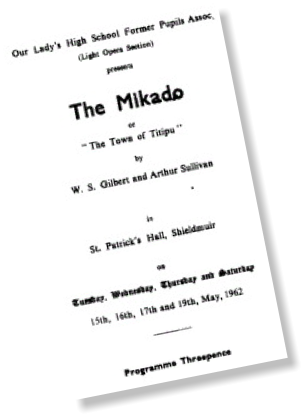
The Society's first production was Gilbert and Sullivan's "The Mikado",
performed in May 1962 (ticket 4/-!) in St. Patrick's Parochial Hall in Shieldmuir
(Craigneuk), Wishaw. Principal parts were played. by James O'Neil (Nanki-
Poo), Alan Wright (The Mikado), Kathleen Milton (Yum-Yum), Margaret
McCarthy (Katisha), Frank McMahon (Pooh-Bah) and Tommy McNally (Ko-ko).
The show was an outstanding success and was followed by other G&S
productions until 1966, when The Society moved to Motherwell Town Hall to
present The Mikado once again and The Desert Song in the same year.

The Seventies (notes by Raymond Lunny)
The next milestone in the Society's history was the move to Motherwell Concert
Hall in 1970. The production of the Vagabond King (March 1970) was due to be
put on in the previous November, but the Concert Hall complex was behind
schedule and was not completed until springtime. Our show was the first to be
presented in the Concert Hall and, like the Hall itself, was surrounded with
problems. Scenery was not received when expected and had to he painted by
ourselves the weekend before the show! Costumes were being sewn up during
the first night and the buses went on strike the same day! Nevertheless the show
was highly successful and attended by over 4500 patrons.
In November of the same year we performed our first presentation of Iolanthe,
produced by two former D’Oyly Carte principals, Beryl Dixon and Fred Sinden.
Many have regarded this as the Society's finest production.
In 1972 we attended our first Waterford Festival of Light Opera with The
Gondoliers and came in third place. Many neutrals felt that an even higher
position was deserved. We did not have to wait too long, however, for greater
success and won the overall first prize in 1975 with our production of The Gypsy
Baron, a show which was an outstanding success at home as well a few weeks
later.
In addition to stage performances the Society has taken part in the TV show,
Opportunity Knocks and did a solo presentation of Songs of Praise, both in 1974

The Eighties (notes by Dan Hughes)
The “eighties” is probably best portrayed as the “immediate post-Waterford era” in the history of the
Society, Jack Tait’s 1979 production of “Die Fledermaus” being our last competitive entry in the famous
Irish Festival. Jack stayed with the Society the following year to produce “The Desert Song”. Although full
of many fine performances, this show is well remembered for the appearance of Moses, a real live donkey,
on stage. (No funny comments, please!!)
The following year, Alan Jones began a long association with the Society as producer with a beautiful
traditional presentation of “The Mikado”. This was followed with an adventurous journey into the best
known of the Offenbach operettas, “Orpheus In The Underworld” which featured a highly perilous journey
for three principals in a flying balloon! In June 1982, the Society was part of the Choir of 1000 Voices
which greeted the Pope on his visit to Glasgow.
Franz Lehar’s “The Count of Luxembourg” and Rudolf Friml’s “Rose Marie” took the Society on to
new ground by introducing our audiences to shows not usually included in musical societies’ repertoire.
There following two years of revivals of well-loved favourites, “The Merry Widow” and “Iolanthe” which put
the Society in good heart as they looked forward to their Silver Jubilee Year, 1987.
The choice of show for this commemorative year was greeted with gasps when it was announced -
“The Arcadians”. This was regarded as a rather tired old “pot-boiler” from the dim and distant past. But,
thanks to a brilliant, original production by Alan Jones, the show turned out to be a great success and
proved to be just right for the occasion.
The following year the Society unearthed a relatively unknown show by Oscar Strauss, “A Waltz
Dream” which turned out to be an amusing, melodic tit-bit. It was certainly different from out usual
presentations.
The decade drew to a close with a revival of Gilbert and Sullivan’s well loved “The Gondoliers”
performed in 1989. But earlier in the year, a very significant departure was made from our usual repertoire.
Two long standing friends of the Society, Betty Pearson and Irene McMillan were asked to compile,
produce and direct a Revue. What transpired was not the usual collection of songs, sketches, etc. but an
extravaganza of music and movement. A format, style and standard of production/performance was set
then, which has survived in various guises till the present time.
The one constant throughout the decade was the dedication, inspiration and all-round musical
direction of Hugh McAlinden. Associated with the Society since its inception, Hugh’s service has rightly
been honoured by his elevation to be one of the Honorary Presidents of the Society.

The Nineties (notes by Laurie Thompson)
In the early '90s, the Society was not yet committed to mounting two major productions a year. Any
Spring shows were still generally low-budget shows designed to counter the ever-increasing costs of the
November productions - though the revues, compiled and directed by Betty Pearson and Irene McMillan
were large-scale, demanding and extremely popular with audiences, some set in a cabaret-style layout
with the audience seated at tables.
From 1990 - 93, a diet of two such revues, Offenbach, Strauss, and G&S was served, to be
followed, in Spring 1994, by a show which changed the outlook of the Society - a "Betty and Irene" revue
called "Something Old, Something New". The "Old" was an Old-time Music Hall, but the first half was an
hour-long version of "Hello Dolly" with all main musical numbers and enough dialogue to tell the story.
The performance was acclaimed by our supporters. We had discovered the Broadway musical.
Following a lively "La Vie Parisienne" in November 1994, we performed our first full-length
Broadway show, "My Fair Lady" produced by Dougal Stirrat in Spring 1995, with Eddie Pearson as
Higgins and Janis Cunningham in the title role. Audiences declared it the best show we had ever done,
although the Society was not ready to abandon operetta. The next few years saw a pattern of revue-in-
the-spring and light opera in November.
In 1998, we returned to the American musical with a fixed-set, dramatic version of "Oklahoma"
produced by Gillian Archibald, filling the width of the Motherwell Concert Hall. The large cast were all
involved in the ballet! In November we performed our last operetta for many years, "Orpheus in the
Underworld". The show was our first produced by Peter Mcfarlane. MD David Henderson and AMD Gerry
McCrorie were assisted by a young David Fisher (of whom more later). As a production, it was a
resounding success, greeted with gales of laughter in all the right places, but ticket sales simply could
not support the production costs involved in putting on such a high-standard show. Much soul-searching
followed.
In Spring 1999, we were restored to financial comfort by a splendid "Betty and Irene" revue called
"Music Kaleidoscope" in which we were joined by our old friend Duncan Cameron doing inspired "stand-
up". That November saw the beginning of a series of American musicals with "South Pacific", produced
by Peter Macfarlane with David Fisher now installed as MD. Margaret Hay choreographed. "It was like a
breath of fresh air blowing through the society" said one long-term supporter and occasional critic. It set
the scene for the next few years

Into 2000, with a large-scale production of "Fiddler on the Roof", and the arrival of choreographer
Joanne Rooney - again using the full width of the Concert Hall. A powerful Tevye (Mark McLean) inspired
the rest of the cast and Joanne worked miracles of miracles with the choreography. For some in the
audience it was even better than "South Pacific". Could we keep up the standard - and the pace?
"Anything Goes" was the first show of its genre we had attempted, with big routines, tap dance, and a
comedy style new to us. It worked and readied us for our then most challenging show, most demanding in
rehearsal time. "The Melody Lingers On" has apparently proved almost too much for some companies, like
us, underestimating what was needed to do this splendid tribute to Irving Berlin full justice.
November 2001 saw "Guys and Dolls" in which newer members shone and the company's confidence
with the genre consolidated. This was followed in May, 2002 by our 40th anniversary show, "Singing Is Our
Forte", a spectacularly-presented revue.
Then, the near-impossible, "Chess", with just a few months rehearsal. Press reviews were "rave", a
view shared by most of our audiences, but not all. For the performers it was an unforgettable experience,
both for the satisfaction of actually putting on a well-received performance and the relief of surviving the
most punishing rehearsal schedule of our lives.
In Spring, 2003, an intimate revue in the circular auditorium of Motherwell's GLO Centre. A cast of 36
sounded like double the number, thanks to the superb acoustics. With a maximum of seven rows deep, the
audience had never been closer - with nowhere for us to hide.
In November, 2003, we returned to Light Opera with a refreshing new production of "Die Fledermaus".
In May,2004, Janis Cunningham was a magnificent Dolly Levi in "Hello, Dolly!". The joyously musical and
funny "Kiss Me Kate" followed in November and, in May, 2005, we transformed the Concert Hall into a
sumptuous "Café Chantant".
For November, the American fantasy on Scotland, "Brigadoon" was performed with a number of
experimental features, in the Concert Hall. Our last show directed by Peter Macfarlane and choreographed
by Joanne Rooney was a revue created by the Production Team called "Strictly Rodgers and
Hammerstein”. David Fisher was still with us for "Calamity Jane" in November, joined by David Carmichael
as producer and our own Catherine Paterson as choreographer. Calam was a rumbustious Alyson Taylor
with the evergreen Jonathan Procter as Wild Bill. "Carousel" followed in Spring, 2007. A splendid
November "My Fair Lady" featured Esther O'Hara in the title role with Jonathan as Higgins. In 2008 we
performed an all-new "Café Chantant" and the very-funny "Me and My Girl". "WestEnd2Broadway" was a
staged concert touring Motherwell Concert Hall (promoted in association with them) Eastwood Park
Theatre and the East Kilbride Arts Centre, the latter two in aid of charities. "Oklahoma" followed, produced
by Tom Gemmell.
PREVIOUS PRODUCTIONS
1962 : The Mikado
1963 : The Gondoliers ; The Pirates of Penzance
1964 : HMS Pinafore ; Trial By Jury
1966 : The Mikado ; The Desert Song
1968 : The Merry Widow ; Pink Champagne
1970 : The Vagabond King ; Iolanthe
1971 : The Student Prince
1972 : The Gondoliers
1973 : The Merry Widow
1974 : The Yeomen of the Guard
1975 : The Gipsy Baron
1976 : Merrie England
1977 : Frederica
1978 : Olde Tyme Music Hall ; The Grand Duchess
1979 : Die Fledermaus
1980 : The Desert Song
1981 : The Mikado
1982 : Orpheus in the Underworld
1983 : The Count of Luxembourg
1984 : Concert & Trial By Jury ; Rose Marie
1985 : The Merry Widow
1986 : Iolanthe
1987 : Silver Jubilee Concert ; The Arcadians
1988 : A Waltz Dream
1989 : Revue ; The Gondoliers
1990 : Revue ; La Belle Helène
1991 : Die Fledermaus
1992 : The Pirates of Penzance
1993 : Smile With Style ; The Gipsy Baron
1994 : Something Old, Something New; La Vie Parisienne
1995 : My Fair Lady ; The Merry Widow
1996 : Moments of Magic ; The Desert Song
1997 : Viva Mexico!
1998 : Oklahoma! ; Orpheus in the Underworld
1999 : Musical Kaleidoscope ; South Pacific
2000 : Fiddler on the Roof ; Anything Goes!
2001 : The Melody Lingers On ; Guys and Dolls
2002 : Singing Is Our Forte ; Chess
2003 : This One's For You : Die Fledermaus
2004 : Hello, Dolly! ; Kiss Me Kate
2005 : Café Chantant ; Brigadoon
2006 : Strictly Rodgers & Hammerstein ; Calamity Jane
2007 : Carousel ; My Fair Lady
2008 : Café Chantant 2008 ; Me and My Girl
2009 : WestEnd2Broadway ; Oklahoma
2010 : Sing! Sing! Sing! ; Red Hot & Cole
2011: No production
2012: Musical Gold, past, present, future ; A Christmas Carol
2013: Guys and Dolls
2014: Anything Goes
2015: White Christmas
2016: Calamity Jane
2017: Fiddler on the Roof
2018: Oliver!
2019: Kiss Me Kate
A Little Light History
This section attempts to cover the 60-odd years since the
Society was founded.
Inevitably, it relies on the recollections of members past and present. If
you think we’ve got it wrong, let us know, but we don’t want to get
involved in antagonism and so won’t guarantee to “correct” the story to
everyone’s satisfaction!
To get some detail of each of the decades covered, click the heading.
You may have to adjust the settings for your browser to enable this
feature. Best of luck!
There is a Gallery page (being re-compiled from scratch) with
pictures from past events.
Here are two of our earlier logos: